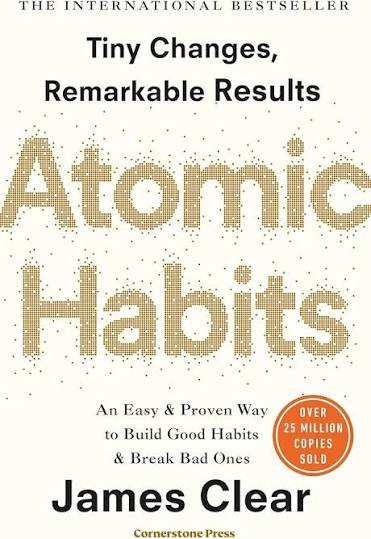
Complete Full-Text Guide to Atomic Habits by James Clear
A practical, real-world guide to building good habits, breaking bad ones, and making tiny daily changes that compound into massive results over time.
Prologue & Central Premise
Ever set an ambitious New Year's resolution only to abandon it three weeks later? You buy brand-new gym shoes, promise to wake up at 5:00 AM, and swear you'll read 50 pages every night. Then real life hits, motivation evaporates, and you end up feeling guilty.
James Clear wrote Atomic Habits to tell you something reassuring: you are not broken, and your willpower is not the problem.
The real problem is your system. When you focus on tiny, almost unnoticeable changes—what Clear calls atomic habits—they quietly compound over time into massive personal transformations.
Most people think big success requires giant, heroic moves. This book proves that getting just 1% better every day makes you 37 times better by the end of the year. It gives you a practical, repeatable blueprint to change your habits without burning out.
Chapter I: The Math of Tiny Gains: Why Small Habits Matter
The Math of Tiny Gains: Why Small Habits Matter
It is so easy to overestimate the importance of one defining moment and underestimate the value of making daily improvements. We convince ourselves that massive success requires massive action.
Clear shows that getting just 1% better each day adds up fast. If you improve by 1% every single day for a year, you end up 37 times better. But if you get 1% worse each day, your good habits drop down to almost nothing.
Time makes good choices pay off bigger, and bad choices hurt more. Good habits turn time into your best friend; bad habits turn time into your enemy.
The Math of Tiny Gains: Why Small Habits Matter — Core Mechanics
At the core of this principle lies a foundational dynamic: Improving tiny parts of your daily routine by just one percent rather than trying to overhaul your entire life at once.. Understanding this reality is vital because Habits are the compound interest of self-improvement. The effect of daily choices multiplies over time.
Consider how this operates in practice: Saving $5 a day seems pointless on Monday, but over 10 years with interest, it compounds into financial security.
Habits often appear to make no difference until you cross a critical threshold. Clear calls this the Plateau of Latent Potential. You can heat an ice cube from 25 degrees to 31 degrees with no visible melting, but at 32 degrees it turns to water. Your early effort was not wasted; it was simply stored.
Chapter II: Goals vs. Systems: Why Setting Targets Isn't Enough
Goals vs. Systems: Why Setting Targets Isn't Enough
Almost every Olympian wants a gold medal. Almost every candidate wants the job. If winners and losers share the same goals, the goal itself cannot be what separates the winners from the losers.
Goals tell you where you want to go. Systems are the processes that actually get you there. When you spend all your energy obsessing over the outcome, you neglect the daily routine that produces the outcome.
Fall in love with the daily process, not just the finish line.
Goals vs. Systems: Why Setting Targets Isn't Enough — Core Mechanics
At the core of this principle lies a foundational dynamic: Focusing on the repeated daily process rather than fixing your mind on a distant target.. Understanding this reality is vital because Achieving a goal only changes your life for a single moment. Fixing your system changes your results permanently.
Consider how this operates in practice: Cleaning your messy room gives you a tidy room for one day (goal). Building a rule to put things away immediately keeps your room clean forever (system).
It Isn't About Productivity; It's About Self-Respect
On the surface, this book looks like a manual on daily routines, checklists, and productivity hacks. But the deeper truth is about identity and self-trust.
Every time you follow through on a tiny habit, you cast a vote for yourself. You prove to your subconscious that you can be trusted to keep promises. That quiet confidence is the real prize.
Chapter III: Identity-Based Habits: Changing Who You Are
Identity-Based Habits: Changing Who You Are
Most people try to change habits from the outside in: they focus on the outcome ('I want to lose 20 pounds'), then the process ('I need to run on a treadmill').
The most lasting habit change happens at the identity level. True behavior change is identity change. When you believe you are an athletic person or an organized person, doing the habits feels natural rather than forced.
The goal is not to read a book; the goal is to become a reader.
Identity-Based Habits: Changing Who You Are — Core Mechanics
At the core of this principle lies a foundational dynamic: Deciding who you want to be, then casting small votes for that identity with every action you take.. Understanding this reality is vital because Every action is a vote for the type of person you wish to become. No single vote decides the election, but the votes add up.
Consider how this operates in practice: Refusing a cigarette by saying 'No thanks, I am not a smoker' works far better than saying 'No thanks, I am trying to quit.'
Chapter IV: The Four Laws: How to Build Any Good Habit
The Four Laws: How to Build Any Good Habit
Clear organizes human behavior into a simple loop: Cue, Craving, Response, and Reward. To build a good habit, you invert this into four actionable laws.
1. Make it obvious: Design your environment so the visual cues are right in front of you. 2. Make it attractive: Bundle temptations. 3. Make it easy: Reduce friction. 4. Make it satisfying: Reward yourself immediately.
Build the simple habit first before trying to make it perfect.
The Four Laws: How to Build Any Good Habit — Core Mechanics
At the core of this principle lies a foundational dynamic: Scaling any new habit down so it takes less than two minutes to do.. Understanding this reality is vital because A habit must be established before it can be improved. You cannot optimize a habit that does not exist.
Consider how this operates in practice: Instead of 'read before bed,' your habit is 'read one page.' Instead of 'run 5 miles,' your habit is 'put on my running shoes.'
Epilogue & The Living Legacy
You do not need a miraculous breakthrough to turn your life around. You just need to win a few small, ordinary choices every single day.
When you treat habits as votes for your future self, progress stops feeling like a punishment and starts feeling like quiet personal pride.
Trust the math of compounding. Be patient with the results, and relentless with the daily system.