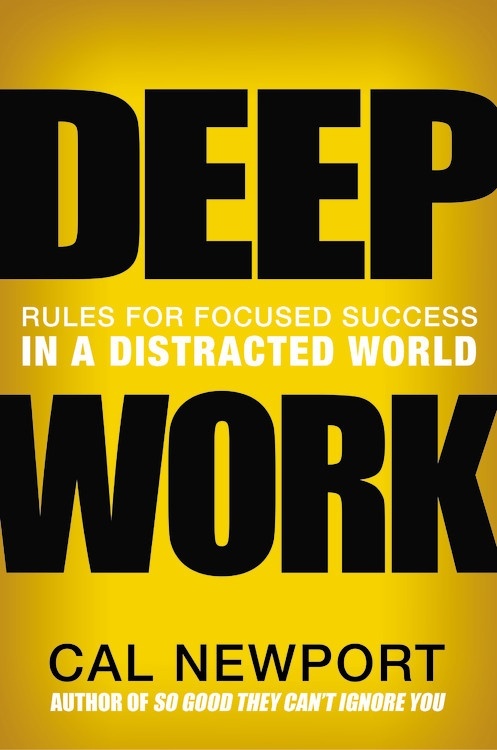
Complete Full-Text Guide to Deep Work by Cal Newport
The definitive treatise on why the ability to perform intense, distraction-free intellectual work is becoming an ultra-rare economic superpower in our hyper-fragmented, notification-addicted economy.
Prologue & Central Premise
In 1922, Swiss psychoanalyst Carl Jung was engaged in a fierce intellectual battle with Sigmund Freud. To revolutionize the field of analytical psychology, Jung did something that modern workers would consider insane: he bought a plot of land in Bollingen on the shores of Lake Zurich and built a two-story stone fortress with his bare hands.
There was no electricity and no telephone. Jung locked himself in a private second-floor stone study with an iron key every morning at 7 AM, chopping wood, preparing his own meals, and writing in uninterrupted silence for six hours straight. In that stone solitude, he birthed some of the most influential psychological frameworks of the 20th century.
Compare that to the modern knowledge worker: sitting under humming LED office lights, toggling between 28 browser tabs, answering Slack pings every 4 minutes, and checking email 75 times a day. We have exchanged the deep, rare genius of Carl Jung for the frantic, shallow busyness of digital hamsters. Deep Work is the battle cry to take your mind back.
If you spend your working life in reactive mode—jumping at every ping, email, and meeting—you produce shallow, easily automatable work that can be outsourced to an algorithm or low-cost freelancer. To thrive in the AI and digital era, you must master the rare skill of quickly learning complex things and producing elite output at high speed.
Chapter I: The Deep Work Hypothesis: The New Economic Superpower
The Deep Work Hypothesis: The New Economic Superpower
Newport presents a compelling thesis: our economy is undergoing a massive restructuring. Two groups will capture the lion's share of financial rewards in the coming decades: those who can orchestrate and leverage complex intelligent machines, and those who are undisputed masters in their specialized domain.
To join either group, you must master two core abilities: 1. The ability to quickly master hard, complex things (e.g. machine learning algorithms, complex financial instruments, high-level strategy). 2. The ability to produce at an elite level, in terms of both quality and speed. Neither ability is possible without deep work.
Maximized focus intensity beats exhausted overtime every single time.
The Deep Work Hypothesis: The New Economic Superpower — Core Mechanics
At the core of this principle lies a foundational dynamic: High-Quality Work Produced = (Time Spent) × (Intensity of Focus).. Understanding this reality is vital because Most knowledge workers try to increase output solely by increasing 'Time Spent' (working 60-70 hours a week), but because their 'Intensity of Focus' is diluted to 0.2 by Slack and notifications, their total output remains mediocre.
Consider how this operates in practice: Working for 3 hours with 1.0 intensity (zero phone, zero browser tabs) produces 3.0 units of output. Working for 8 hours with 0.2 intensity produces only 1.6 units of output—less than half the result in more than double the time.
Newport notes that J.K. Rowling retreated to a luxury suite in the Balmoral Hotel in Edinburgh with no internet access to finish the final chapters of Harry Potter and the Deathly Hallows because the distractions of everyday home life were fracturing her narrative flow.
The $4,000 Flight to Nowhere for a Book Deadline
Peter Shankman, an entrepreneur and author, was facing an impossible publisher deadline: he had to write an entire book manuscript in two weeks, but his calendar was choked with meetings, phone calls, and domestic interruptions.
He realized that the only place he felt completely focused was on airplanes without Wi-Fi. Shankman booked a round-trip business-class ticket from New York to Tokyo.
He boarded the flight at JFK, opened his laptop, and typed for 12 hours straight. He landed in Tokyo, spent two hours in the airport lounge drinking an espresso and showering, boarded the immediate return flight back to New York, and typed for another 12 hours.
When he touched down at JFK 30 hours later, he had completed the entire manuscript. The ticket cost him $4,000, but the delivered manuscript secured a six-figure publishing advance.
He realized that buying complete cognitive isolation was the highest-ROI investment of his professional career.
Chapter II: The Myth of Multitasking and Attention Residue
The Myth of Multitasking and Attention Residue
Most knowledge workers believe they are harmlessly 'multitasking.' They think: 'I'll just glance at my email for 15 seconds while waiting for this code to compile, or check this Slack ping while writing this proposal.' Newport cites groundbreaking research by business professor Sophie Leroy on 'Attention Residue.'
When you switch your focus from Task A to Task B, your attention does not cleanly follow like a spotlight. A thick residue of cognitive processing remains stuck on Task B. If you glance at an email from your boss asking an ambiguous question, your brain continues chewing on that email subconsciously, severely degrading your working memory and analytical clarity on Task A for the next 20 minutes.
Never 'just glance' at an inbox while engaged in high-leverage cognitive work.
The Myth of Multitasking and Attention Residue — Core Mechanics
At the core of this principle lies a foundational dynamic: The cognitive lag and mental friction created whenever you glance at a secondary communication channel or unrelated task.. Understanding this reality is vital because Constantly checking inboxes keeps your brain in a permanent state of attention residue, effectively reducing your functional IQ by up to 10 points during deep tasks.
Consider how this operates in practice: A software engineer who writes code while keeping Slack open on a second monitor is operating with a cognitive impairment equivalent to working while sleep-deprived.
Mark Twain wrote Tom Sawyer and Huckleberry Finn in a remote octagonal study on a hill in Quarry Farm, New York. His family had to blow a horn whenever they needed to call him for dinner because he was in such deep immersion.
Instant Responsiveness Destroys True Value
Corporate culture lionizes the employee who answers every email within 90 seconds and responds to Slack at 11 PM.
In reality, this constant accessibility is a lazy substitute for strategic thinking. Anyone can be instantly responsive; almost nobody can build a rare, proprietary software architecture or craft a brilliant corporate strategy.
By making yourself universally available to everyone for minor trivia, you make yourself completely unavailable to the work that actually changes your career trajectory.
Chapter III: The 4 Rules for Executing a Deep Life
The 4 Rules for Executing a Deep Life
Willpower is a finite biological resource. If you sit down at your desk with vague hopes of 'being focused today,' the path of least resistance (checking news, social media, or email) will inevitably conquer you by 2 PM. Newport establishes four non-negotiable rules for structuring a deep life.
Rule #1: Work Deeply (build strict rituals and environmental boundaries). Rule #2: Embrace Boredom (stop pulling out your phone every 30 seconds). Rule #3: Quit Social Media (evaluate digital tools strictly by their net-positive contribution to your primary goals). Rule #4: Drain the Shallows (ruthlessly cap shallow administrative work).
Boundaries don't restrict your output; boundaries force radical efficiency.
The 4 Rules for Executing a Deep Life — Core Mechanics
At the core of this principle lies a foundational dynamic: Setting a strict, non-negotiable end time for your workday (e.g. 5:30 PM) and organizing your tasks within that container.. Understanding this reality is vital because Parkinson's Law dictates that work expands to fill the time available. When you know you must shut your laptop down at 5:30 PM, you ruthlessly eliminate shallow filler meetings and focus on high-yield tasks.
Consider how this operates in practice: Newport, a tenured computer science professor at Georgetown University who publishes multiple peer-reviewed papers and bestselling books annually, rarely works past 5:30 PM on weekdays and never works on weekends.
Why you must train boredom: if you train your brain to seek a dopamine hit whenever you feel 5 seconds of boredom (like in an elevator or waiting for traffic lights), your brain physically loses the neural wiring required to sit with a hard, frustrating intellectual problem for 90 minutes.
Notification Reactor vs. Deep Work Architect
When navigating these moments, the amateur mistake is The 28-Tab Ping-Pong Champion: Keeps Slack, WhatsApp, and 4 email inboxes open all day. Measures productivity by how quickly they clear unread badges and how many meetings they attended. In sharp contrast, the mastermove is The Monastic Focus Sentry: Schedules two uninterrupted 90-minute deep blocks every morning. Shuts down browser tabs, puts phone in another room, and creates irreplaceable economic value.
When navigating these moments, the amateur mistake is Stimulation Addict in Waiting: Reaches for their smartphone the second an elevator stops or a microwave beeps, reinforcing a neurological intolerance for mental stillness. In sharp contrast, the mastermove is Boredom Resilient Mind: Deliberately walks without headphones, sits in waiting rooms observing the room, and preserves the cognitive endurance needed for hard thinking.
Epilogue & The Living Legacy
The ubiquity of smartphones, notifications, and open-plan offices has created a culture of fractured attention where deep thinking is treated as an inconvenience.
Reject this shallow default. Reclaim your attention, construct your Bollingen Tower, and dedicate yourself to the craft of producing work that stands the test of time.
To build something truly extraordinary, you must be willing to go deep.