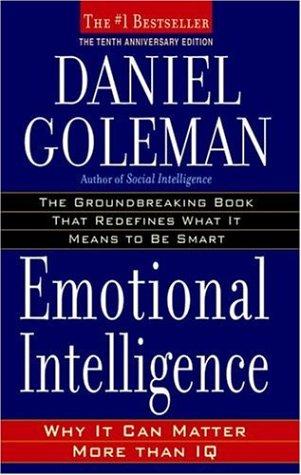
Complete Full-Text Guide to Emotional Intelligence by Daniel Goleman
Daniel Goleman proves that being book-smart is only part of the story—knowing how to manage your feelings and connect with people (EQ) matters much more.
Prologue & Central Premise
We all know someone who had top grades in school but struggled to hold down a job or maintain a relationship. And we all know someone with average test scores who became an inspiring leader or a beloved team builder.
Why does raw academic smartness fail to predict real-world success? Harvard-trained psychologist Daniel Goleman showed that IQ accounts for only about 20% of life outcomes.
The remaining 80% is driven by Emotional Intelligence (EQ): how you handle stress, tune into other people's feelings, and govern your own impulses.
You can be a technical genius, but if you lose your temper in meetings, panic under pressure, or misread social cues, people will refuse to work with you. EQ is the master skill that unlocks all other skills.
Chapter I: The Emotional Brain: What Is an Amygdala Hijack?
The Emotional Brain: What Is an Amygdala Hijack?
Inside the human brain, sensory data passes through the emotional center (the amygdala) before it reaches the logical prefrontal cortex. This wiring evolved to save our ancestors from sabertooth tigers.
In the modern world, an aggressive email or a rude comment can trigger the exact same emergency alarm. The amygdala floods your bloodstream with stress hormones, shutting down rational thought in what Goleman calls an 'amygdala hijack.'
Count to six when triggered: it takes about six seconds for rational chemicals to reach the brain.
The Emotional Brain: What Is an Amygdala Hijack? — Core Mechanics
At the core of this principle lies a foundational dynamic: A sudden wave of anger or panic that takes over your brain before your logical mind can step in.. Understanding this reality is vital because It explains why smart people scream in arguments or send regrettable text messages.
Consider how this operates in practice: Slamming a door in anger during a family disagreement, only to feel embarrassed two minutes later.
Chapter II: The Five Pillars of Emotional Intelligence
The Five Pillars of Emotional Intelligence
Goleman breaks EQ into five concrete competencies: 1. Self-Awareness (knowing what you feel), 2. Self-Regulation (managing destructive impulses), 3. Motivation (passion to work for internal reasons), 4. Empathy (sensing others' feelings), and 5. Social Skills (handling relationships).
Self-awareness is the bedrock. If you cannot name your anxiety or irritation, you become a puppet to it.
Name it to tame it.
The Five Pillars of Emotional Intelligence — Core Mechanics
At the core of this principle lies a foundational dynamic: Putting words to your feelings (e.g., 'I am feeling envious right now').. Understanding this reality is vital because Brain scans prove that naming an emotion instantly reduces activity in the amygdala and activates the reasoning cortex.
Consider how this operates in practice: Saying to yourself 'I feel defensive because my idea was challenged' instead of snapping at your team.
Empathy Is a Competitive Advantage, Not Soft Fluff
In aggressive business cultures, empathy is often dismissed as weak or soft. Goleman demonstrates that empathy is actually high-precision pattern recognition.
Leaders who can read the unspoken anxieties and motivations of their team, clients, and partners build trust faster, resolve conflicts before they explode, and retain the best talent.
Chapter III: The Marshmallow Test: The Power of Self-Regulation
The Marshmallow Test: The Power of Self-Regulation
Goleman highlights Walter Mischel's famous Stanford marshmallow test. Four-year-olds were given a marshmallow and told: you can eat it now, or wait 15 minutes and get two marshmallows.
Tracking these children decades later revealed that the kids who waited grew up to have higher SAT scores, lower rates of drug addiction, and vastly better careers. Self-regulation is the root of discipline.
Discipline is choosing what you want most over what you want right now.
The Marshmallow Test: The Power of Self-Regulation — Core Mechanics
At the core of this principle lies a foundational dynamic: Saying no to a quick treat right now so you can get something much better later.. Understanding this reality is vital because It is the emotional engine behind saving money, studying, and staying healthy.
Consider how this operates in practice: Choosing to cook a healthy meal at home instead of ordering fast food on an impulse.
Epilogue & The Living Legacy
A high IQ in a person with low emotional intelligence is like a racecar with no steering wheel: powerful, fast, and prone to catastrophic crashes.
When you learn to observe your feelings without being enslaved by them, you gain the superpower of staying calm in the middle of chaos.
Treat your emotions not as enemies to suppress, but as messengers to understand.