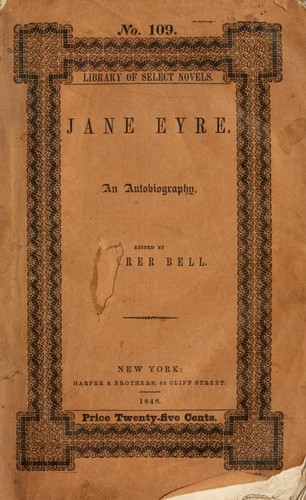
Complete Full-Text Guide to Jane Eyre by Charlotte Brontë
An orphaned, plain, and impoverished young woman asserts her moral equality in a stratified world, falls in love with the brooding Mr. Rochester, and refuses to sacrifice her self-respect for passion.
Prologue & Central Premise
In 1847, Victorian heroines in popular novels were expected to be wealthy, gorgeously beautiful, obedient, and completely dependent on men.
Then Charlotte Brontë created Jane Eyre: a plain, poor, orphaned girl who looked the wealthy master of Thornfield Hall directly in the eye and said:
'Do you think, because I am poor, obscure, plain, and little, I am soulless and heartless? You think wrong!—I have as much soul as you—and full as much heart!... It is my spirit that addresses your spirit; just as if both had passed through the grave, and we stood at God’s feet, equal—as we are!'
Jane Eyre was an absolute revolution. It is the story of a woman who refuses to be anyone's servant, mistress, or second-class citizen, no matter how hard life tries to crush her.
How often do people stay in toxic relationships or unfair jobs because they are afraid of being alone or poor?
Jane Eyre faces the ultimate test: the man she loves with all her heart begs her to become his secret mistress, offering luxury, warmth, and affection.
Jane walks away into the freezing moors with zero money rather than violate her own principles. It is the ultimate manifesto on personal integrity.
Chapter I: The Red-Room and Lowood: Forging the Will
The Red-Room and Lowood: Forging the Will
As a ten-year-old orphan living with her wealthy, abusive Aunt Reed, Jane is locked in the terrifying 'Red-Room' where her uncle died. When her cruel cousin John Reed beats her, Jane fights back fiercely.
She is shipped off to Lowood Institution, a cold charity school where girls starve on burnt porridge and die of typhus. Her gentle friend Helen Burns teaches Jane a profound lesson: endurance, patience, and not allowing cruelty to turn your heart into a furnace of hatred.
Protect your boundaries without poisoning your own heart.
The Red-Room and Lowood: Forging the Will — Core Mechanics
At the core of this principle lies a foundational dynamic: Standing up for your dignity without stooping to the ugly tactics of your abusers.. Understanding this reality is vital because Uncontrolled rage destroys you; quiet moral clarity wins the long game.
Consider how this operates in practice: Reporting workplace harassment calmly with documentation rather than getting into a screaming match in the hallway.
Jane learns that rebellion does not mean wild, uncontrolled fury; it means disciplined, unyielding quiet self-respect.
Chapter II: Thornfield and the Meeting of Equals
Thornfield and the Meeting of Equals
Jane takes a job as a governess at Thornfield Hall. Her employer, Edward Rochester, is not a handsome fairytale prince: he is dark, moody, sarcastic, and scarred by past mistakes.
Instead of treating Jane like an invisible servant, Rochester is captivated by her razor-sharp honesty. When they sit by the fireplace, they debate philosophy, art, and human nature as intellectual equals.
Be a whole person, not someone else's ornament.
Thornfield and the Meeting of Equals — Core Mechanics
At the core of this principle lies a foundational dynamic: Maintaining your personal identity and independent voice inside a romantic partnership.. Understanding this reality is vital because Losing yourself in a partner breeds resentment and insecurity.
Consider how this operates in practice: Continuing your personal hobbies, friendships, and financial goals after moving in with a partner.
Rochester proposes marriage. Jane accepts, but she refuses to become his pampered doll. When he tries to bury her in expensive jewels and silks, she resists: 'I will be myself, Mr. Rochester.'
The Strange Laugh in the Night Was Rochester's Wife
Throughout Jane's stay at Thornfield, eerie demonic laughter echoed in the hallways, Rochester's bed was set on fire, and a guest was bitten in the arm.
Jane was led to believe this was the work of an eccentric, drunken servant named Grace Poole.
In reality, Grace Poole was a high-paid keeper watching over Bertha Mason, Rochester's legal wife, whose violent outbursts were kept hidden just two floors above Jane's bedroom.
Chapter III: The Madwoman in the Attic and the Great Temptation
The Madwoman in the Attic and the Great Temptation
At the altar, the wedding is stopped. Rochester's secret is revealed: fifteen years earlier in Jamaica, his family tricked him into marrying Bertha Mason, who suffered from violent insanity. Rochester hid her in the third-floor attic with a nurse to avoid a public asylum.
Rochester takes Jane in his arms, weeping, and begs her: 'Come with me to France. We will live as husband and wife. Who will be hurt? I have no real wife, and you have no family to offend.'
Respect yourself most when you have the least support.
The Madwoman in the Attic and the Great Temptation — Core Mechanics
At the core of this principle lies a foundational dynamic: Choosing painful righteousness over comfortable, compromising temptation.. Understanding this reality is vital because If you compromise your core ethics for passion, you destroy the self-respect that made you capable of real love.
Consider how this operates in practice: Refusing to sign off on illegal accounting practices, even when your boss threatens to fire you before Christmas.
This is Jane's ultimate crisis. She loves Rochester with every fiber of her soul. She has no home, no money, and no family. Becoming his mistress would mean warmth, passion, and luxury.
Jane speaks her most famous words: 'I care for myself. The more solitary, the more friendless, the more unsustained I am, the more I will respect myself. I will keep the law given by God; sanctioned by man. Laws and principles are not for the times when there is no temptation: they are for such moments as this.' She slips out of the mansion before dawn with only a small parcel of bread.
Chapter IV: Rejection of the Cold Monk and the Return to Love
Rejection of the Cold Monk and the Return to Love
Jane is taken in by the Rivers family and becomes a village schoolteacher. Her cousin St. John Rivers, a brilliant and austere clergyman, discovers her real identity and reveals that she has inherited twenty thousand pounds from an uncle. Jane immediately splits the fortune four ways with her cousins.
St. John demands that Jane marry him and accompany him to India as a missionary's wife. He does not love her; he wants her as an efficient, hardworking tool for his religious ambition.
Do not marry out of obligation or pity; marry as equals.
Rejection of the Cold Monk and the Return to Love — Core Mechanics
At the core of this principle lies a foundational dynamic: A romantic union where neither partner has financial, emotional, or social dominance over the other.. Understanding this reality is vital because Only equals can experience complete trust and unforced intimacy.
Consider how this operates in practice: Both partners contributing equally to household decisions, finances, and emotional support without power games.
Jane realizes that marrying Rochester without marriage was a temptation of passion, but marrying St. John without love would be a death sentence for her heart. She refuses him.
She returns to Thornfield to find it burned to ash by Bertha, who leaped from the roof. Rochester, now blind and maimed from trying to rescue everyone, lives alone in a secluded cottage. Jane approaches him not as a poor, dependent servant, but as an independent, wealthy woman. They marry as true partners, and in time, his sight partially returns to see their newborn child.
Epilogue & The Living Legacy
Jane Eyre is the ultimate anthem of personal integrity.
It shows that you do not need wealth, connections, or physical perfection to command respect.
When you hold fast to your conscience, refuse to be treated as less than equal, and respect yourself in the dark, you cannot be broken by anything on Earth.