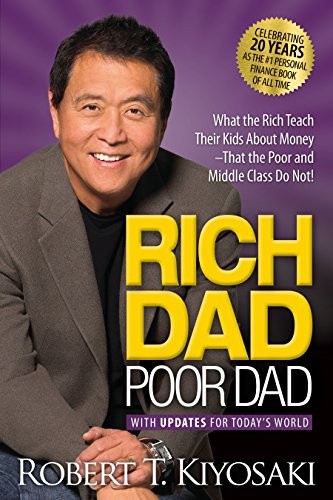
Complete Full-Text Guide to Rich Dad Poor Dad by Robert Kiyosaki
The landmark guide to financial literacy, distinguishing assets from liabilities, escaping the Rat Race, and making money work for you.
Prologue & Central Premise
Most of us spent over a decade in school and never had a single class on how money actually works. We were told: study hard, get good grades, find a stable job, and pay your bills until you retire at 65.
Robert Kiyosaki grew up with two father figures who showed him two completely opposite financial realities. His real dad (Poor Dad) was a highly educated school superintendent who worked hard his whole life but died with unpaid bills. His best friend's dad (Rich Dad) never finished eighth grade, but built a massive business empire in Hawaii.
The difference between them wasn't how much money they made. It was what they believed about money.
If you don't know the difference between an asset and a liability, earning a bigger paycheck won't make you wealthy—it will just make you buy a bigger car and take on bigger debt. This book teaches you how to step off the financial treadmill.
Chapter I: Assets Put Money In; Liabilities Take Money Out
Assets Put Money In; Liabilities Take Money Out
Kiyosaki says the biggest reason people struggle financially is that they buy liabilities thinking they are assets.
Accountants use complicated balance sheets, but Kiyosaki reduces the whole game to one simple rule: if it puts cash into your pocket every month, it is an asset. If it takes cash out of your pocket, it is a liability. Rich people buy assets like dividend stocks, rental properties, and small businesses. The middle class buys liabilities like expensive cars, boats, and large homes that require endless upkeep.
Buy things that pay you to own them.
Assets Put Money In; Liabilities Take Money Out — Core Mechanics
At the core of this principle lies a foundational dynamic: A dead-simple test: looking at whether an item increases your bank balance every month without your physical labor.. Understanding this reality is vital because It stops you from confusing status symbols with genuine wealth.
Consider how this operates in practice: A rental duplex that brings in $500 profit each month is an asset. A sports car with a $700 monthly payment is a liability.
Chapter II: The Rat Race: Why More Income Doesn't Help
The Rat Race: Why More Income Doesn't Help
When an employee gets a raise, what do they usually do? They celebrate by moving into a bigger apartment or buying a new car. Their expenses rise in lockstep with their income.
Kiyosaki calls this the Rat Race. You work for the company to earn money, you work for the government through income taxes, and you work for the bank through mortgage and credit card interest. You run faster and faster on the wheel, but you never get anywhere.
It is not how much money you make; it is how much money you keep.
The Rat Race: Why More Income Doesn't Help — Core Mechanics
At the core of this principle lies a foundational dynamic: The automatic human tendency to increase spending as soon as income increases.. Understanding this reality is vital because It keeps doctors and lawyers earning $300k a year living paycheck to paycheck.
Consider how this operates in practice: Getting a $5,000 bonus at work and immediately financing a new luxury watch instead of buying index funds.
A Higher Salary Won't Save You
Most people spend their entire lives praying for a promotion or a raise, convinced that an extra $1,000 a month will solve all their stress.
Kiyosaki reveals that more money without financial education simply accelerates your spending. If your financial habits are broken, a million-dollar lottery win will just bankrupt you faster. Change your habits first.
Chapter III: Work to Learn, Not Just to Earn
Work to Learn, Not Just to Earn
Kiyosaki's Poor Dad believed in deep specialization: get a PhD, become an expert in one narrow job, and stay there for security. Rich Dad believed in broad practical skills: learn a little about sales, accounting, marketing, management, and real estate.
If you only know how to write software or cook food, you are at the mercy of someone who knows how to run a business. When you learn how to sell and communicate, you can turn any craft into an empire.
Look for jobs for what you will learn, not just for what you will be paid.
Work to Learn, Not Just to Earn — Core Mechanics
At the core of this principle lies a foundational dynamic: Combining a technical skill with sales and financial literacy to create immense personal leverage.. Understanding this reality is vital because Sales is the single most valuable business skill you can ever master.
Consider how this operates in practice: A brilliant writer who learns marketing sells 100,000 books; a brilliant writer who disdains marketing sells 100 copies.
Epilogue & The Living Legacy
Financial freedom is not about being greedy or hoarding gold coins. It is about taking control of your time.
When your living expenses are covered by assets that generate cash while you sleep, you wake up every morning with the freedom to choose your work, spend time with people you love, and live on your own terms.
Stop working for money. Start building the systems that make money work for you.