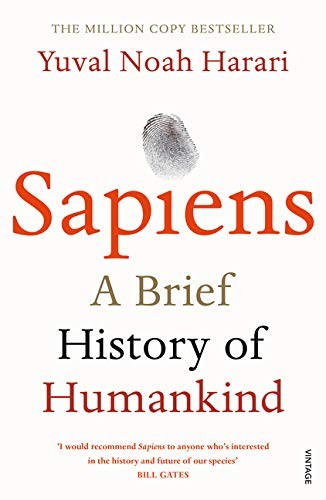
Complete Full-Text Guide to Sapiens: A Brief History of Humankind by Yuval Noah Harari
70,000 years ago, Homo sapiens was an insignificant ape minding its own business in Africa. Harari explains how our unique ability to believe in shared fictional stories allowed us to cooperate in millions and rule the globe.
Prologue & Central Premise
100,000 years ago, Earth was walked by at least six different human species: Homo sapiens, Neanderthals, Homo erectus, Denisovans, and others.
None of them were special. Sapiens were middle-tier primates foraging for nuts, hunting small animals, and living in terror of big cats.
Yet today, only one human species remains, and we possess nuclear weapons, fly into space, and alter the climate of the entire planet.
How did an insignificant ape become the absolute ruler of planet Earth? The answer is not that we were stronger, faster, or had bigger brains. The answer is that we learned how to tell stories.
We take things like dollar bills, human rights, countries, and stock markets as eternal, physical realities.
Harari reveals that none of these things exist in the physical universe—they exist purely in our shared collective imagination.
Understanding how these 'shared fictions' work frees you from unquestioned cultural dogmas and helps you see how human society is actually constructed.
Chapter I: The Power of Imagined Realities
The Power of Imagined Realities
You can never convince a chimpanzee to give you a banana by promising him twenty bananas in chimpanzee heaven after he dies. Animals only live in an objective reality: trees, rivers, lions, and fruit.
Sapiens live in a dual reality. Alongside trees and rivers, we created an imagined reality: gods, nations, corporations, and human rights.
When you change the stories people believe, you change how millions behave.
The Power of Imagined Realities — Core Mechanics
At the core of this principle lies a foundational dynamic: A concept that exists only because large groups of people mutually agree to believe in it.. Understanding this reality is vital because It is the operating system of all modern legal, political, and financial institutions.
Consider how this operates in practice: A green piece of paper with George Washington's face on it having purchasing power solely because everyone trusts it.
Consider a corporation like Peugeot. What is it? It is not the cars, not the factories, and not the assembly-line workers. If an earthquake swallowed every Peugeot factory, the company could borrow money, hire new workers, and build new cars. Peugeot is a legal fiction—an imagined story created by human lawyers that millions of people agree to treat as real.
Chapter II: The Agricultural Trap: History's Biggest Fraud
The Agricultural Trap: History's Biggest Fraud
For thousands of years, history books taught that the shift from hunter-gatherer foraging to farming was a glorious leap forward for human wellbeing. Harari calls this a complete myth.
Foragers worked 3 to 4 hours a day, ate a varied diet of fruits, nuts, and meats, and rarely suffered from famine or infectious epidemics.
Be cautious when adopting 'time-saving' tools that create new burdens.
The Agricultural Trap: History's Biggest Fraud — Core Mechanics
At the core of this principle lies a foundational dynamic: Adopting an innovation to make life easier, only to become completely dependent on it and work harder than before.. Understanding this reality is vital because It explains why modern conveniences (like smartphones) often increase our stress rather than free our time.
Consider how this operates in practice: Buying email software to save time on letters, resulting in receiving 200 urgent messages a day.
When humans domesticated wheat, wheat actually domesticated humans. Farmers spent 12 hours a day clearing rocks, weeding, and hauling water under the blazing sun. Their spines bent, their teeth rotted from grains, and a single drought meant mass starvation. The agricultural revolution allowed populations to explode, but made the life of the average individual far harder and more anxious.
We Are Gods Who Don't Know What We Want
Humans have acquired divine powers: we can split atoms, design new genomes, and communicate instantly across planets.
Yet Harari concludes that we are more dissatisfied and anxious than ever. We have become self-made gods, accountable to no one, destroying ecosystems and alienating ourselves.
Is there anything more dangerous than dissatisfied and irresponsible gods who do not know what they want?
Chapter III: The Universal Religion of Money
The Universal Religion of Money
Throughout history, humans were divided by religion, race, language, and culture. Christians and Muslims fought bloody crusades, but both happily traded using the same gold dinars.
Money is not coins or paper; money is a psychological system of mutual trust. It is the most universal and tolerant system ever created.
Trust is the invisible cement holding global civilization together.
The Universal Religion of Money — Core Mechanics
At the core of this principle lies a foundational dynamic: Trust that exists between minds; it functions because everyone believes everyone else respects it.. Understanding this reality is vital because It explains why market crashes happen when collective confidence shakes.
Consider how this operates in practice: A bank run: a perfectly solvent bank collapses simply because people panic and believe it will collapse.
Why does a dollar bill work? Not because the government says so, but because you know that the grocery clerk, the landlord, and the car mechanic will accept it tomorrow. Money works because everyone believes that everyone else believes in it.
Chapter IV: The Scientific Revolution: Ignoramus
The Scientific Revolution: Ignoramus
Before 1500, ancient religions and traditions claimed to know all important truths: everything you needed to know was in the Bible, the Quran, or the Vedas. If something wasn't there, it was unimportant.
The Scientific Revolution began with a radical revolution in human psychology: admitting ignorance. The motto of modern science is 'Ignoramus'—we do not know.
Saying 'I don't know' is the first step toward real wisdom.
The Scientific Revolution: Ignoramus — Core Mechanics
At the core of this principle lies a foundational dynamic: A cultural framework that celebrates questioning dogmas and testing hypotheses with data.. Understanding this reality is vital because It transforms failures into learning opportunities and sparks continuous innovation.
Consider how this operates in practice: A tech team running A/B experiments rather than letting the highest-paid person's opinion dictate design.
When Europeans drew world maps with massive blank spaces labeled 'Terra Incognita,' they admitted they were missing information. This humility, combined with observation and math, drove the explosive growth of modern science, technology, and economic empires.
Epilogue & The Living Legacy
Sapiens shows that our world is made of stories we invented.
Because our legal, economic, and social systems are invented fictions, we have the power to reinvent them whenever they no longer serve human flourishing.
Never treat human-made institutions as unchangeable laws of nature. Be the author of better stories that bring more kindness, freedom, and meaning to our world.