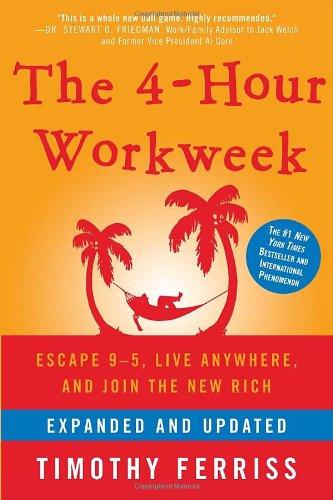
Complete Full-Text Guide to The 4-Hour Workweek by Tim Ferriss
Tim Ferriss challenges the traditional retirement model, offering a revolutionary blueprint to eliminate busywork, automate income, and live anywhere in the world right now.
Prologue & Central Premise
Why spend 40 years of your prime youth chained to a desk, staring at spreadsheets for 50 hours a week, just so you can finally retire at 65 when your joints ache and your energy is spent?
In 2007, an exhausted sports nutrition entrepreneur named Tim Ferriss reached the point of utter burnout. Instead of giving up, he radically restructured his business, outsourced operations to India, and flew to Argentina to dance tango.
The result was The 4-Hour Workweek—the bible of lifestyle design that proved that true wealth is not having a million dollars in a bank account, but having freedom of time and mobility.
Most people mistake being busy for being productive. This book provides a ruthless scalpel to cut away meaningless administrative work, harness global outsourcing, and design a life you don't need a vacation from.
Chapter I: Relative Income vs. Absolute Income
Relative Income vs. Absolute Income
Ferriss introduces a simple comparison: Person A works 80 hours a week as a corporate lawyer and makes $150,000 a year. Person B runs an automated online business working 10 hours a week and makes $60,000 a year.
Who is richer? In absolute terms, Person A makes more. But in relative terms (hourly wage and freedom), Person B earns $115/hour and can live in Bali or Portugal, while Person A earns $36/hour, is stressed, and has zero control over their calendar. The New Rich focus on relative income.
Freedom is the multiplier of money.
Relative Income vs. Absolute Income — Core Mechanics
At the core of this principle lies a foundational dynamic: Measuring wealth by how much free time and location freedom you have, not just the number on your paycheck.. Understanding this reality is vital because It frees you from the status trap of working 100 hours a week just to buy expensive toys you have no time to enjoy.
Consider how this operates in practice: Making $4,000 a month remotely while living in Thailand gives you a higher quality of life than making $10,000 a month in Manhattan with $8,000 in fixed expenses.
Chapter II: Elimination: The 80/20 Rule and Parkinson's Law
Elimination: The 80/20 Rule and Parkinson's Law
Most knowledge workers fill their day with 'productive procrastination': checking emails, formatting slides, and attending status meetings.
Ferriss combines two laws: 1. Pareto's 80/20 Principle (identify the 20% of activities that generate 80% of your income, and ruthlessly discard the rest). 2. Parkinson's Law (a task will swell in perceived importance and complexity in relation to the time allotted for its completion). If you give yourself a week to write a proposal, it takes a week; if you give yourself 90 minutes, it takes 90 minutes.
Never do well what should not be done at all.
Elimination: The 80/20 Rule and Parkinson's Law — Core Mechanics
At the core of this principle lies a foundational dynamic: Cutting out fake busywork so you can focus entirely on the few tasks that produce 80% of your results.. Understanding this reality is vital because It instantly eliminates hours of pointless busywork from your week.
Consider how this operates in practice: Checking email only twice a day (at 12:00 PM and 4:00 PM) instead of keeping your inbox open in a browser tab all day.
Retirement Is the Worst-Case Scenario
Society treats retirement as the golden reward at the end of life. Ferriss argues that retirement is actually an admission of defeat: it implies you spent 40 years doing something you disliked just to buy freedom at the very end.
The goal of lifestyle design is not to sit on a beach sipping margaritas for 40 years (which leads to boredom and depression in about three weeks). The goal is to sprinkle mini-retirements of deep learning, adventure, and creative passion throughout your entire life.
Chapter III: Automation and Liberation: The Muse Model
Automation and Liberation: The Muse Model
Instead of building a company that requires your daily management, Ferriss advocates creating a 'muse'—an automated product business (information, software, niche physical goods) that generates steady cash flow with minimal intervention.
By combining online payment processing, third-party fulfillment centers, and virtual assistants with clear decision trees, the business runs without you. You become an owner, not an employee in your own company.
Delegate decisions, not just tasks.
Automation and Liberation: The Muse Model — Core Mechanics
At the core of this principle lies a foundational dynamic: An automated setup where software and trusted remote services handle customer support and shipping for you.. Understanding this reality is vital because It separates how much money you earn from the hours you spend sitting at a desk.
Consider how this operates in practice: Setting up rules allowing your customer service assistant to issue refunds under $50 without asking for your approval.
Epilogue & The Living Legacy
The standard life script—school, 9-to-5, retirement—is an artificial social contract, not a biological law.
You have the right to question the default path, strip away the meaningless busywork, and design a life built around energy, freedom, and genuine curiosity.
Work hard on what matters, automate the rest, and reclaim your time. Life is too short to live on deferred hopes.