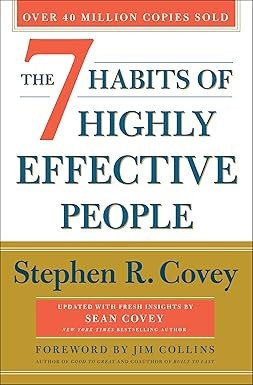
Complete Full-Text Guide to The 7 Habits of Highly Effective People by Stephen R. Covey
Stephen Covey shares a clear, honest framework for solving everyday problems, building strong character, and achieving real success.
Prologue & Central Premise
Have you ever spent weeks rushing around putting out fires, answering emails, and attending meetings, only to realize at the end of the month that you haven't made any real progress on what actually matters to you?
Stephen Covey noticed that modern self-help obsesses over surface-level charm: social personality tricks, body language hacks, and speed-reading gimmicks. He called this the Personality Ethic.
In The 7 Habits, Covey demonstrates that lasting fulfillment and genuine leadership come from the Character Ethic: aligning your daily actions with timeless principles like integrity, service, and responsibility.
This is not a book of quick productivity hacks. It is an enduring operating system for your life. It ensures that the ladder of success you are climbing is actually leaning against the right wall.
Chapter I: Private Victory: Mastering Yourself (Habits 1 to 3)
Private Victory: Mastering Yourself (Habits 1 to 3)
You cannot succeed with other people if you cannot manage yourself. Covey calls Habits 1, 2, and 3 the Private Victory.
Being proactive means recognizing that you are the author of your life. Reactive people let the weather, traffic, or other people's moods dictate their happiness. Proactive people carry their own weather.
Work on yourself, not on others.
Private Victory: Mastering Yourself (Habits 1 to 3) — Core Mechanics
At the core of this principle lies a foundational dynamic: The circle of things you have direct power to change (your habits, your tone, your work ethic) versus the circle of things you merely worry about (the news, the economy, past mistakes).. Understanding this reality is vital because Focusing on your influence expands it; obsessing over your concern shrinks your power.
Consider how this operates in practice: Instead of complaining that your boss is disorganized, organize your own project so clearly that it makes their job effortless.
Chapter II: Time Management: The Quadrant II Secret (Habit 3)
Time Management: The Quadrant II Secret (Habit 3)
Most people live in a state of emergency. They spend their days in Quadrant I (urgent and important crises) or Quadrant III (urgent phone calls and interruptions that aren't actually important).
Effective people organize their lives around Quadrant II: things that are important, but NOT urgent. This includes exercise, long-term planning, relationship building, reading, and skill development. If you don't schedule your priorities, your crises will schedule you.
The key is not to prioritize what is on your schedule, but to schedule your priorities.
Time Management: The Quadrant II Secret (Habit 3) — Core Mechanics
At the core of this principle lies a foundational dynamic: Proactively dedicating time to foundational activities before they blow up into urgent crises.. Understanding this reality is vital because It prevents burnout and drives true long-term compounding.
Consider how this operates in practice: Scheduling regular health check-ups and gym workouts so you don't end up with an emergency hospital visit.
The Personality Ethic vs. The Character Ethic
Most modern career advice tells you to polish your image, network aggressively, and smile on command. Covey shows that this is like painting the leaves of a tree whose roots are dying.
If your core character lacks honesty, responsibility, and humility, your charm will eventually be seen as manipulation. Real power flows outward from who you are, not from how you appear.
Chapter III: Public Victory: Teamwork and Empathy (Habits 4 to 6)
Public Victory: Teamwork and Empathy (Habits 4 to 6)
Once you are independent, you can achieve the highest human state: working smoothly with other people to get much bigger things done together.
Covey's Fifth Habit is legendary: 'Seek first to understand, then to be understood.' Most people listen with the intent to reply, think only about themselves and get ready to argue back while the other person is still speaking.
People don't care how much you know until they know how much you care.
Public Victory: Teamwork and Empathy (Habits 4 to 6) — Core Mechanics
At the core of this principle lies a foundational dynamic: Listening with your eyes and heart to truly understand the other person's emotional reality and worldview.. Understanding this reality is vital because Understand the real problem before trying to give advice. You cannot solve a human problem until the person feels completely heard.
Consider how this operates in practice: Listening to a frustrated coworker without offering advice until they say, 'Yes, you completely understand how I feel.'
Epilogue & The Living Legacy
Effectiveness is not about packing more frantic tasks into a busy calendar. It is about living an integrated life rooted in timeless character principles.
When you move from reactive blaming to proactive ownership, you stop feeling like a victim of circumstances and become the deliberate architect of your life.
Lead yourself with integrity first; only then can you genuinely inspire and serve others.