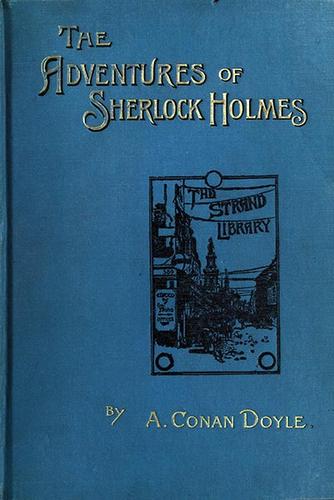
Complete Full-Text Guide to The Adventures of Sherlock Holmes by Arthur Conan Doyle
The world’s first consulting detective, Sherlock Holmes, solves Victorian London’s most baffling mysteries with his faithful friend Dr. Watson. A masterclass in logic, razor-sharp observation, and cognitive clarity.
Prologue & Central Premise
How many steps are there on the staircase leading up to your apartment or house?
You have walked up those steps hundreds of times. But if someone asked you to name the exact number, could you do it?
When Dr. Watson fails this exact test, Sherlock Holmes gives him the legendary lesson: 'You see, but you do not observe. The distinction is clear.'
Most of us go through life half-blind, skimming the surface of our surroundings. Sherlock Holmes became the most famous fictional character in history because he showed what a human brain can accomplish when it pays 100% attention.
We live in a world of distraction, rushing between notifications and making decisions based on hasty gut feelings.
Holmes represents the power of deep observation, disciplined deduction, and resisting the urge to jump to conclusions before you have facts.
Applying his mental models will make you sharper in negotiations, debugging code, reading people, and solving professional problems.
Chapter I: You See, But You Do Not Observe
You See, But You Do Not Observe
Watson sees a man walking into the room; Holmes sees a retired marine sergeant who was wounded in the left arm, served in Afghanistan, and has financial worries.
How? Holmes notices the man's military carriage despite his limp, the weathered skin of the tropics on his wrists, his left arm held stiffly from an old muscle tear, and his slightly frayed cuffs.
Look beyond the surface; every detail is a breadcrumb.
You See, But You Do Not Observe — Core Mechanics
At the core of this principle lies a foundational dynamic: Deliberately paying attention to subtle physical cues and questioning their underlying cause.. Understanding this reality is vital because It reveals hidden truths that people are trying to conceal or ignore.
Consider how this operates in practice: Noticing during a business meeting that someone's smile never reaches their eyes and their foot is tapping anxiously.
Holmes explains that observation is not magic—it is the habit of connecting visual details to logical causes. Most people let their eyes wander passively; Holmes actively questions what every scratch, smudge, and wrinkle means.
Chapter II: Never Theorize Before You Have Data
Never Theorize Before You Have Data
Holmes repeatedly scolds Watson and the Scotland Yard detectives for making a fatal cognitive error: 'It is a capital mistake to theorize before one has data. Insensibly one begins to twist facts to suit theories, instead of theories to suit facts.'
When Inspector Lestrade arrives at a crime scene, he immediately decides on a suspect (usually the person who looks guiltiest) and then ignores every clue that contradicts his guess.
Let the facts dictate your theory, never your theory dictate the facts.
Never Theorize Before You Have Data — Core Mechanics
At the core of this principle lies a foundational dynamic: Refusing to commit to a conclusion until you have gathered sufficient objective evidence.. Understanding this reality is vital because It prevents you from making costly assumptions based on gut feeling or prejudice.
Consider how this operates in practice: A software engineer investigating a server crash by inspecting raw error logs rather than guessing 'it must be the database.'
Holmes does the opposite: he collects every scrap of data—footprints, dust, cigar ashes—without forming an opinion. Only when the facts form an unbroken chain does he allow himself to identify the culprit.
The Silliest Mysteries Were the Most Dangerous
In 'The Red-Headed League,' a man is paid four pounds a week simply to copy the Encyclopedia Britannica in an empty office because of his red hair.
It sounds like a ridiculous prank. But Holmes deduces that the entire absurd job was created just to keep the pawnbroker away from his shop for four hours a day while bank robbers tunneled underneath into a bullion vault.
The more bizarre a detail seems on the surface, the simpler the underlying criminal motive.
Chapter III: The Brain Attic: Ruthless Mental Focus
The Brain Attic: Ruthless Mental Focus
In A Study in Scarlet, Watson is horrified to learn that Holmes doesn't know the Earth revolves around the Sun. When Watson explains Copernican astronomy, Holmes promptly tells him he will do his best to forget it.
Holmes explains his philosophy: 'I consider that a man's brain originally is like a little empty attic, and you have to stock it with such furniture as you choose. A fool takes in all the lumber of every sort... until the knowledge which might be useful to him gets crowded out.'
Do not fill your mental attic with junk you will never use.
The Brain Attic: Ruthless Mental Focus — Core Mechanics
At the core of this principle lies a foundational dynamic: Deliberately choosing what knowledge and information to consume and what to ignore.. Understanding this reality is vital because Information overload causes mental fatigue and poor decision-making.
Consider how this operates in practice: Unsubscribing from celebrity gossip newsletters to spend that 30 minutes reading technical documentation.
Holmes keeps his mental attic stocked only with things relevant to crime: 140 varieties of tobacco ash, London street maps, poisons, and legal precedents. He ruthlessly filters out trivial gossip and useless trivia.
Chapter IV: Eliminating the Impossible
Eliminating the Impossible
Holmes's ultimate investigative algorithm is simple: 'Eliminate all other factors, and the one which remains must be the truth.'
In 'The Speckled Band,' Helen Stoner fears for her life after her sister dies mysteriously in a locked room with no marks of violence, right after whistling was heard. The local doctor suspects gypsies.
Eliminate the impossible, and whatever remains is your answer.
Eliminating the Impossible — Core Mechanics
At the core of this principle lies a foundational dynamic: Methodically proving false hypotheses until only the verifiable truth remains.. Understanding this reality is vital because It clears away clutter and cuts directly through confusing scenarios.
Consider how this operates in practice: Diagnosing a car that won't start: checking battery, fuel pump, and alternator one by one until the culprit is isolated.
Holmes inspects the room methodically: the bed is bolted to the floor, the bell-rope doesn't ring any bell, and the ventilator leads not outside, but into the stepfather's adjoining room. Having eliminated poison in food, physical intruders, and supernatural causes, Holmes deduces that a venomous snake was introduced through the ventilator. By eliminating the impossible, the bizarre truth reveals itself.
Epilogue & The Living Legacy
Sherlock Holmes is not an eccentric superhero; he is a testament to what the human mind can do when it refuses to be lazy.
In an age of distraction and shallow thinking, the ability to observe carefully, think logically, and see through illusions is a true superpower.
Open your eyes, pay attention to the details, clear out your mental attic, and observe the world as it actually is.