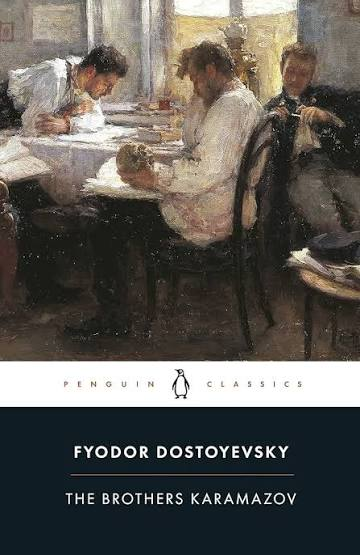
Complete Full-Text Guide to The Brothers Karamazov by Fyodor Dostoevsky
Four brothers deal with the murder of their corrupt father, Fyodor Karamazov. An epic clash between wild passion, cold intellectual atheism, pure spiritual compassion, and the dark consequences of ideas.
Prologue & Central Premise
If you took the human soul and split it into four distinct parts, what would they look like?
You would get the four Karamazov brothers: Dmitri (wild passion and lust for life), Ivan (brilliant intellectual skepticism and doubt), Alyosha (gentle empathy, faith, and practical love), and Smerdyakov (bitter resentment, cynicism, and spite).
Their father, Fyodor, is a vulgar, shameless monster who cheats his sons out of money and competes with his eldest son for the same woman.
When the old man is found brutally beaten to death in his bedroom, all four brothers are caught up in the blame. Because one of them committed the act, but all of them wished for it in their hearts.
The Brothers Karamazov is widely considered one of the greatest novels ever written because it wrestles with life's biggest questions: If God exists, why is there innocent suffering? Are humans really capable of handling freedom? What keeps society together when morality breaks down?
Dostoevsky gives the strongest possible arguments to atheism and skepticism, then counters them not with abstract philosophy, but with lived compassion.
Reading this book transforms how you view moral responsibility, family dysfunction, and the power of everyday kindness.
Chapter I: The Rebellion of Ivan and the Problem of Suffering
The Rebellion of Ivan and the Problem of Suffering
Ivan Karamazov represents pure, sharp intellect. In a famous conversation with his brother Alyosha at a tavern, Ivan explains why he cannot accept faith.
He doesn't deny God's existence; he rejects the harmony of the universe because of the suffering of innocent children. He collects real newspaper clippings of horrific abuse inflicted on young kids and asks Alyosha: 'If you could build a paradise where everyone was happy forever, but it required torturing just one tiny child to tears, would you consent to be the architect under those conditions?'
Do not dismiss people's honest moral outrage at the world's unfairness.
The Rebellion of Ivan and the Problem of Suffering — Core Mechanics
At the core of this principle lies a foundational dynamic: The philosophical dilemma of how cruelty and innocent suffering can exist in a world created by a good power.. Understanding this reality is vital because It is the deepest emotional hurdle to finding meaning in life.
Consider how this operates in practice: Asking how a kind and caring universe could allow childhood illness or natural disasters.
Alyosha quietly answers: 'No, I wouldn't.' Ivan concludes that he must 'return his ticket' to such a creation. Reason alone cannot reconcile innocent agony with a loving universe.
Chapter II: The Grand Inquisitor: The Burden of Freedom
The Grand Inquisitor: The Burden of Freedom
Ivan recites a poem he wrote called 'The Grand Inquisitor.' In 16th-century Seville, during the Spanish Inquisition, Jesus returns to Earth, performs quiet miracles, and is immediately arrested by the 90-year-old Cardinal Inquisitor.
In the dark dungeon, the Inquisitor tells Jesus that he was wrong to offer humans spiritual freedom. Most people, says the Inquisitor, cannot handle freedom—it causes them endless anxiety, war, and hunger.
Real freedom is difficult and demanding, but surrendering it makes you a spiritual slave.
The Grand Inquisitor: The Burden of Freedom — Core Mechanics
At the core of this principle lies a foundational dynamic: The human tendency to surrender personal personal freedom to controlling and oppressive systems in exchange for security and easy answers.. Understanding this reality is vital because It explains why populations willingly vote for dictators and cultish movements.
Consider how this operates in practice: Following an influencer's strict daily rules blindly because thinking for yourself feels too exhausting.
What humans really want is 'miracle, mystery, and authority.' They want someone to feed them bread, tell them what to believe, and take away the agony of choice. At the end of the Inquisitor's long lecture, Jesus does not argue back. He simply walks over and gently kisses the old man on his bloodless lips. The Inquisitor opens the door and whispers: 'Go, and come no more.'
The Servant Did It, But All Were Guilty
Dmitri was framed: the blood on his hands was from hitting a servant while escaping, not his father.
Smerdyakov committed the actual murder and stole the money.
Yet Smerdyakov hangs himself before he can testify, leaving Dmitri to be found guilty. Dmitri accepts the punishment voluntarily, saying: 'I am guilty not of his death, but of wishing his death in my heart. I will go to Siberia to suffer for everyone.'
Chapter III: The Murder and the Dangerous Principle
The Murder and the Dangerous Principle
Ivan coined the phrase: 'If God does not exist, everything is permitted.' To Ivan, this was an abstract philosophical debate about the foundation of ethics.
But the bitter servant Smerdyakov takes it literally. Smerdyakov thinks: if everything is permitted, then killing an abusive old man who hoards three thousand rubles is not a crime—it is just practical efficiency.
Never treat destructive ideas as harmless intellectual toys.
The Murder and the Dangerous Principle — Core Mechanics
At the core of this principle lies a foundational dynamic: The understanding that our words, beliefs, and attitudes influence how others behave around us.. Understanding this reality is vital because We do not live in isolation; careless cynicism can give others permission to commit cruelty.
Consider how this operates in practice: A podcaster joking about scamming people, inspiring a follower to steal life savings from seniors.
When Ivan discovers that Smerdyakov acted on his words, Ivan is shattered. He realizes that an intellectual who sits in a study spinning cynical theories bears direct moral responsibility when someone acts them out in the real world.
Chapter IV: Father Zosima's Law: Active Love and Universal Responsibility
Father Zosima's Law: Active Love and Universal Responsibility
Alyosha's spiritual mentor, Elder Zosima, offers the novel's answer to Ivan's despair. Zosima does not give complicated philosophical proofs.
Instead, he teaches two things: 'Active Love' and the idea that 'Each of us is responsible to everyone, for everyone, and for everything.' When you realize that human beings are deeply connected, you stop blaming the world and start taking responsibility for bringing kindness into your small corner.
Love is measured by what you do, not by what you post.
Father Zosima's Law: Active Love and Universal Responsibility — Core Mechanics
At the core of this principle lies a foundational dynamic: Demonstrating love through patient, everyday labor and service rather than emotional speeches.. Understanding this reality is vital because Loving humanity in theory is easy; loving the annoying person sitting next to you requires true spiritual strength.
Consider how this operates in practice: Volunteering every Saturday morning at a food shelter instead of posting angry tweets about world hunger.
At the end of the novel, after Dmitri is convicted and Ivan is hospitalized, Alyosha attends the funeral of Ilyusha, a poor schoolboy. He gathers the other boys and asks them never to forget this moment of love. The memory of goodness, Alyosha says, will protect them from becoming bitter men as they grow up.
Epilogue & The Living Legacy
The Brothers Karamazov is the ultimate showdown between the head and the heart.
It shows that a brilliant intellect can dissect the universe, but only active love can put it back together and give it meaning.
Do not let the pain of the world turn you into a bitter spectator. Be an Alyosha: step into the mess, listen with compassion, and choose to love anyway.