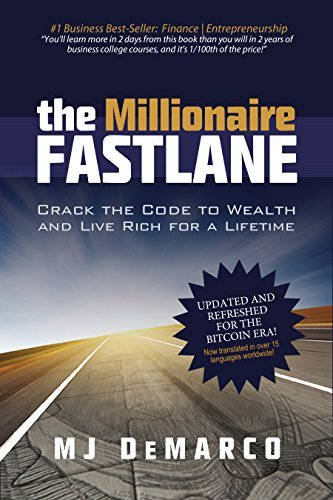
Complete Full-Text Guide to The Millionaire Fastlane by MJ DeMarco
A brutally honest demolition of the traditional 40-year corporate grind and the slow-saving mutual fund myth, replaced with an engineering framework for building scalable, high-leverage business systems.
Prologue & Central Premise
In the freezing Chicago winter of 1996, MJ DeMarco was 26 years old, delivering Chinese food and driving airport limos in a rusted $900 Ford Escort with a broken heater. He was sleeping on his mother's basement sofa, drowning in $30,000 of debt, and watching his college peers wear suit-and-tie shackles to corporate cubicles.
Every financial guru on television was barking the same gospel: cut your coupons, save 10% of your paycheck into index funds, don't buy that $4 latte, and by the time you're 67 years old, you'll be a millionaire! DeMarco looked at that roadmap and called it what it really was: financial malpractice.
Why would anyone trade five miserable days of their youth for two weekend days of freedom, just to enjoy wealth when they are in an orthopedic walker? The Millionaire Fastlane is the antidote: an unapologetic mathematical blueprint for divorcing wealth from time.
Trading your hours for dollars guarantees a mathematical ceiling on your life. If you sell your time, you can only make 24 hours of money per day. To build real, lasting wealth while you still have your health and youth, you must own an asymmetric system that serves millions of people while you sleep.
Chapter I: The Slowlane Lie: 40 Years of Hope and Pennies
The Slowlane Lie: 40 Years of Hope and Pennies
DeMarco pulls no punches when critiquing traditional personal finance advice. The mainstream playbook instructs young people to graduate with $50k in student loans, sit in traffic for 2 hours a day, buy index funds, clip grocery coupons, and deny themselves simple joys so that—by year 2065—they can have $1.5 million when their hips hurt and their energy is gone.
This strategy fails for two mathematical reasons: uncontrollable limited leverage (you can only work so many hours before burning out) and uncontrollable market risk (a market drop of 40% can erase a decade of compounding right when you need to retire). The Slowlaner lives on hope; the Fastlaner lives on control.
Never anchor your wealth equation to variables you cannot scale to infinity.
The Slowlane Lie: 40 Years of Hope and Pennies — Core Mechanics
At the core of this principle lies a foundational dynamic: Slowlane wealth is based on: Wealth = (Hourly Wage × Hours) + (Investments × Compound Interest). Both factors have hard mathematical ceilings.. Understanding this reality is vital because Because there are only 24 hours in a day, your earning potential is mathematically constrained from day one.
Consider how this operates in practice: A corporate lawyer making $250/hr still caps out at $500,000/yr and must sit at their desk 60 hours a week. A software developer making $0.50 per app download selling to 2 million people earns $1,000,000 with zero additional hourly work.
DeMarco points out that the gurus selling you the 'frugal Slowlane' books (like Dave Ramsey or Suze Orman) didn't get rich by investing in 401(k)s or clipping coupons; they got rich by selling millions of books and seminar tickets through a scalable Fastlane business system.
The Midnight Blizzard Epiphany
In 1997, after another 14-hour shift driving a limousine in sub-zero Chicago slush, MJ DeMarco parked in a dark lot with ice crusting his windshield. He had $900 in his bank account, no health insurance, and his back throbbed from hauling luggage for rich executives.
He noticed that customers constantly asked the same question: 'Where can I find a reliable limousine service in Miami or New York?' At the time, the internet was in its infancy. DeMarco taught himself Perl and HTML from library books, moved to Phoenix with $900 in cash, and built a website called Limos.com.
He didn't own a single car. Instead, he charged limo operators across America $10 to $40 for every customer lead his website routed to them. In 2000, during the height of the tech boom, he sold that lead generation engine for $1.2 million. He was 31 years old.
He didn't buy a fleet of limousines; he built a software bridge that connected desperate buyers with eager sellers across 50 states while he slept.
Chapter II: The Law of Effection: Scale and Magnitude
The Law of Effection: Scale and Magnitude
How do ordinary people become self-made multimillionaires in their 20s and 30s? The answer is never luck; it is Effection. The Law of Effection states: the more lives you affect in an environment you control, either by scale (quantity) or magnitude (depth), the richer you will become.
If you cut hair at a local barbershop, you affect 12 people a day. Your scale is microscopic, so your wealth is microscopic. But if you invent a barbershop scheduling SaaS used by 15,000 barbershops across 4 countries, you affect 150,000 appointments daily. Money flows where scale and magnitude live.
Impact millions, make millions. Impact dozens, make dozens.
The Law of Effection: Scale and Magnitude — Core Mechanics
At the core of this principle lies a foundational dynamic: Scale = Impacting huge numbers of people with small pricing (e.g. 500,000 customers at $20/month). Magnitude = Impacting fewer people with massive life-altering pricing (e.g. 10 enterprise clients at $100,000/year).. Understanding this reality is vital because Unless your vehicle can achieve either extreme scale or extreme magnitude, you cannot produce rapid wealth.
Consider how this operates in practice: An author writing an ebook priced at $15 that sells 100,000 copies online pulls in $1.5M with near-zero marginal distribution cost.
Money isn't selfish; it's a social scorecard. It reflects how much tangible value, convenience, entertainment, or security you have handed to the rest of humanity.
The Fastlane Isn't Easy—It's Just Compressed
People assume 'fast' means 'effortless.' In reality, the Fastlane demands intense, grueling, sweat-soaked dedication.
The difference is that a Slowlaner spreads their suffering across 45 mundane years of corporate obedience, whereas a Fastlaner compresses that entire lifetime of effort into 3 to 5 hyper-focused, sleepless years of architectural creation.
You trade a few years of living like almost nobody will, so you can spend the rest of your life living like almost nobody can.
Chapter III: The C.E.N.T.S. Framework: The 5 Immutable Business Laws
The C.E.N.T.S. Framework: The 5 Immutable Business Laws
Most entrepreneurs fail not because they don't work hard, but because they pick business vehicles that violate fundamental economic laws. DeMarco formulated the C.E.N.T.S. framework as a strict five-part filter for any enterprise.
If a business idea violates even two of these commandments, it will inevitably become an exhausting grind that traps the owner rather than setting them free.
Hard entry barriers protect fat profit margins. If it's easy to start, it's impossible to get rich.
The C.E.N.T.S. Framework: The 5 Immutable Business Laws — Core Mechanics
At the core of this principle lies a foundational dynamic: 1. Control: You must own the platform, not build on someone else's lawn. 2. Entry: High barrier to entry (if anyone can start it in 10 minutes, margins collapse). 3. Need: Solving real customer friction, not selfish passion. 4. Time: The business must operate independently of your physical presence. 5. Scale: The addressable pool must be regional, national, or global.. Understanding this reality is vital because Prevents entrepreneurs from pouring years of life into dead-end freelance gigs or multi-level marketing traps disguised as businesses.
Consider how this operates in practice: Driving for Uber fails Control (Uber sets prices), Entry (anyone with a driver's license can join), and Time (you stop driving, you stop earning). Building a specialized logistics routing tool satisfies all five.
Why dropshipping and MLM fail the C.E.N.T.S. test: in both models, you have zero control over supply chains or pricing, anyone can enter with $50, and you are merely building somebody else's Fastlane.
Slowlane Amateur vs. Fastlane Architect
When navigating these moments, the amateur mistake is Budgeting Lattes & Hoping for 7% Returns: Spends hours clipping coupons, obsessing over $4 coffees, and hoping the S&P 500 averages 8% inflation-adjusted returns so they can have a modest nest egg by age 68. In sharp contrast, the mastermove is Controlling the Revenue Engine: Focuses on growing top-line revenue by 500% through high-margin scalable software, media, or products, using capital to buy back 100% of their waking hours.
When navigating these moments, the amateur mistake is 'I Want to Open a Cupcake Shop!': Starts a business because 'I love baking.' Enters an oversaturated low-margin market with zero barriers to entry, ending up working 80 hours a week for minimum wage. In sharp contrast, the mastermove is 'Where is the Market Bleeding?': Identifies agonizing supply chain delays or terrible customer service in boring B2B niches, builds a 10x cleaner solution, and charges premium prices.
Epilogue & The Living Legacy
You were not put on this earth to spend your best waking hours sitting under fluorescent cubicle lights waiting for a pension that inflation will erode.
The Fastlane is not about greed; it is about reclaiming the single most sacred asset you possess: your autonomous time on this planet.
Build systems that serve humanity at scale, take full ownership of your vehicle, and take your life back.