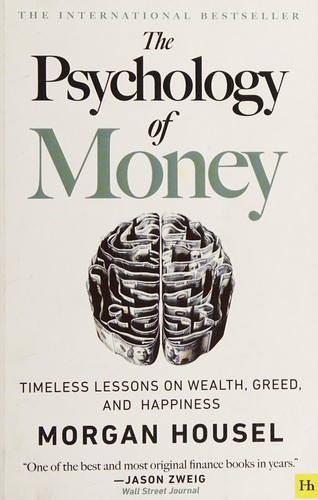
Complete Full-Text Guide to The Psychology of Money by Morgan Housel
Morgan Housel shares 19 short stories exploring the strange ways people think about wealth, ego, and risk, proving that financial success is about human behavior, not spreadsheet math.
Prologue & Central Premise
Doing well with money has surprisingly little to do with how smart you are, and a whole lot to do with how you behave when emotions run high.
You can have a PhD in physics from MIT, understand advanced calculus, and still go bankrupt by panicking during a market downturn. Meanwhile, a retired janitor named Ronald Read who secretly saved small sums in dividend stocks died with an $8 million fortune that he donated to his local library and hospital.
Morgan Housel proves that money is not an engineering problem where you plug numbers into a formula. It is a psychological game of patience, humility, and self-control.
Traditional finance books teach you about formulas, portfolio optimization, and market timing. This book teaches you how to keep your head when everyone else is losing theirs, which is the only thing that actually builds lasting wealth.
Chapter I: No One Is Crazy: Your Background Shapes Your Bets
No One Is Crazy: Your Background Shapes Your Bets
People from different generations, countries, and family backgrounds view money through completely different lenses. A person who grew up during the 2008 financial crisis or hyperinflation views stocks differently than someone who grew up during a 1990s tech boom.
Housel reminds us that when someone buys a lottery ticket or refuses to invest in stocks, they aren't stupid. They are acting on a model of the world formed by their personal life experience. What looks like madness to you makes total sense to them.
Be humble about your assumptions; you haven't seen everything.
No One Is Crazy: Your Background Shapes Your Bets — Core Mechanics
At the core of this principle lies a foundational dynamic: The realization that your personal experience with money makes up maybe 0.00000001% of what has happened in the world, but maybe 80% of how you think the world works.. Understanding this reality is vital because It replaces judgment of others with empathy and self-awareness.
Consider how this operates in practice: Someone whose parents lost their home in a foreclosure preferring cash in a bank account over stocks, even if the math says stocks earn more.
Chapter II: Compounding: The Real Secret of Warren Buffett
Compounding: The Real Secret of Warren Buffett
Warren Buffett is universally recognized as the greatest investor of all time. More than 2,000 books have been written analyzing his stock picks.
Housel points out the real secret: Buffett's skill is investing, but his secret is time. Buffett started investing seriously at age ten. More than 99% of his net worth was accumulated after his 50th birthday. If he had started at age thirty with normal retirement plans, you would never have heard his name.
Endurance beats brilliance in investing.
Compounding: The Real Secret of Warren Buffett — Core Mechanics
At the core of this principle lies a foundational dynamic: The exponential math of leaving your investments alone for decades without interrupting the process unnecessarily.. Understanding this reality is vital because You don't need astronomical annual returns; you just need pretty good returns sustained for an uninterrupted long time.
Consider how this operates in practice: Earning 8% a year for 40 years beats earning 25% a year for 5 years and then cashing out or blowing up.
The Ultimate Dividend Is Freedom
Most people think money is for buying luxury goods, bigger houses, and first-class flights. Housel reveals that the highest form of wealth is having control over your time.
Being able to wake up every morning and say, 'I can work on whatever I want, with whoever I want, for as long as I want' provides a level of happiness that no luxury toy can ever match. Money buys autonomy.
Chapter III: Rich vs. Wealthy: What You Don't Spend
Rich vs. Wealthy: What You Don't Spend
Rich is what you see: the luxury sports car, the expensive designer coat, the Instagram vacation photos. Rich is current income spent to display status.
Wealth is what you do not see. Wealth is the car not purchased, the watch not bought, the stock portfolio quietly compounding in the background. Wealth is an option not yet exercised to buy something later. The world is full of people who look rich but are one missed paycheck away from bankruptcy.
Spending money to show people how much money you have is the fastest way to have less money.
Rich vs. Wealthy: What You Don't Spend — Core Mechanics
At the core of this principle lies a foundational dynamic: Recognizing that wealth is financial options, freedom, and reserves, while riches are often just outward spending.. Understanding this reality is vital because It stops you from trying to impress people who aren't even paying attention to you.
Consider how this operates in practice: Someone earning $200k spending $210k is getting poorer; someone earning $70k spending $50k is building true wealth.
Epilogue & The Living Legacy
Money is not a game you win by being the smartest person in the room or making the most dramatic prediction.
It is a game won by the person who can stay sane, live comfortably beneath their means, avoid catastrophic debt, and let time work its quiet compounding magic.
Aim for financial peace of mind. Use money to buy back your hours, your autonomy, and your sleep.