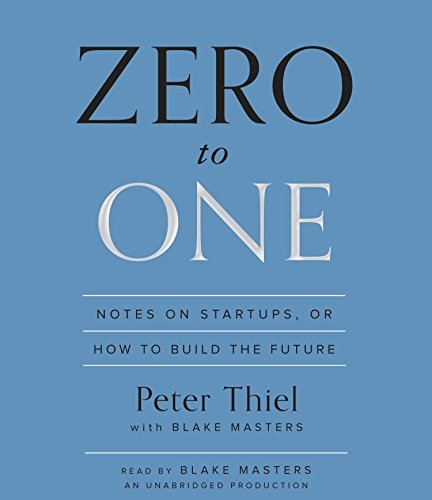
Complete Full-Text Guide to Zero to One by Peter Thiel
PayPal co-founder and legendary venture capitalist Peter Thiel reveals how to build truly transformative companies that create new value rather than copying what already exists.
Prologue & Central Premise
Every time someone launches another copycat social network, search engine, or delivery app, they are not learning from Mark Zuckerberg, Larry Page, or Jeff Bezos.
The next Bill Gates will not build an operating system. The next Larry Page will not build a search engine. If you copy these titans, you are taking the world from 1 to n—adding more of something familiar.
In Zero to One, billionaire investor Peter Thiel shows that true innovation happens when you go from 0 to 1: creating something completely new that the world has never seen before.
Society tells us that competition is healthy and noble. Thiel shows that in business, competition destroys profits and exhausts founders. If you want to build enduring value, you must build a creative monopoly that does something ten times better than anyone else.
Chapter I: The Contrarian Truth: 0 to 1 vs. 1 to n
The Contrarian Truth: 0 to 1 vs. 1 to n
Whenever Thiel interviews job candidates or startup founders, he asks one favorite question: 'What important truth do very few people agree with you on?'
Most people give conformist answers dressed up as rebel opinions. A good contrarian answer reveals a hidden secret about the world. Globalization is taking things that work in one place and spreading them everywhere (1 to n). Technology is doing things that have never been done before (0 to 1). If you only pursue globalization without technology, you create a resource-depleted world.
Do something new, not just something slightly cheaper.
The Contrarian Truth: 0 to 1 vs. 1 to n — Core Mechanics
At the core of this principle lies a foundational dynamic: Creating something genuinely new that solves an unsolved problem and opens up brand new possibilities.. Understanding this reality is vital because It creates massive, life-changing wealth and moves the world forward.
Consider how this operates in practice: Going from the typewriter to a word processor is 0 to 1; building a cheaper typewriter factory is 1 to n.
Chapter II: Competition Is for Losers
Competition Is for Losers
Business textbooks praise perfect competition as the ideal economic state. Thiel argues that for an entrepreneur, competition is a trap that destroys profits.
Consider US airlines versus Google. In 2012, US airlines carried millions of passengers and generated $160 billion in revenue, but made only 37 cents of profit per passenger. Google made $50 billion in revenue and kept 21% of it as profit. Google has a monopoly on search, so it can reinvest billions into self-driving cars and AI. Airlines compete so fiercely on ticket prices that they constantly go bankrupt.
Monopolists lie to protect themselves; competitors lie to seem unique.
Competition Is for Losers — Core Mechanics
At the core of this principle lies a foundational dynamic: A business so uniquely great at what it does that competitors cannot easily copy it, freeing it from brutal price wars.. Understanding this reality is vital because Profits allow companies to treat employees well, think long-term, and invent future breakthroughs.
Consider how this operates in practice: Google in search or eBay in online auctions during its first decade.
Sales Matters Just as Much as Product
In Silicon Valley and engineering cultures, founders foolishly believe that 'if you build a great product, customers will come naturally.'
Thiel shows that distribution and sales are just as critical as the technology. If you invent something amazing but have no viral, direct, or sales channel to get it into people's hands, your company will die. Great salesmanship looks effortless and hidden.
Chapter III: Start Small and Monopolize
Start Small and Monopolize
The biggest mistake first-time founders make is targeting a 1% slice of a giant market (e.g., 'If we can just get 1% of the $100 billion pet food market, we will be rich!').
A 1% slice of a huge market means you are competing against dozens of entrenched giants with zero competitive advantage. Instead, target a tiny, underserved market—even a few thousand people—and become the undisputed #1 dominant player. Once you own that niche, expand into concentric adjacent circles.
Dominate a small market before trying to scale.
Start Small and Monopolize — Core Mechanics
At the core of this principle lies a foundational dynamic: Becoming the undisputed favorite for a small, specific group of people before trying to expand everywhere.. Understanding this reality is vital because It is far easier to be number one in a small niche than to survive in a crowded, noisy ocean.
Consider how this operates in practice: Facebook launching exclusively for Harvard students before opening to other colleges, and only then opening to the world.
Epilogue & The Living Legacy
The future will not happen on autopilot. It will only be built if bold, curious people step outside the herd and create things that do not yet exist.
Do not waste your life competing for small crumbs in crowded, exhausted markets. Find a hidden truth, solve a real problem, and build a creative monopoly that pushes civilization forward.
The most valuable businesses of tomorrow are waiting to be taken from zero to one.